Imagine a small piazza, an outdoor pizza oven, rows of vines and rooms designed after wine barrels. You would guess a hillside somewhere in Italy. It is the Negev. If you are working out where to stay in the Negev Highlands, Carmey Avdat is a good place to begin, because the place itself explains what a stay here is like: a family farm, about five minutes from Sde Boker, built slowly and on purpose, on ground that already knew vines.
A vineyard on top of an older vineyard
The farm was founded in 1998 by Hana and Eyal Yizrael, as part of the Wine Route project in the Negev Highlands. They were, by their own account, already well into life when the family decided to build a farm for growing grapes and making wine. Their children came along, and some of them are now joining the project to carry it on.
The vines went into the ground in 1999, among the first vineyards planted in the modern Negev. They were planted over the remains of an ancient vineyard, about 1,500 years old. Nobody here invented the idea of wine in the desert. The family came back to a conversation the land had started long before them.
Six grape varieties grow in the vineyard: cabernet sauvignon, merlot, petit verdot, barbera, chardonnay and viognier. Together they make roughly a dozen different wines, in small batches, around 5,000 bottles a year. Eyal is the owner, the grower and the winemaker, and he learned the craft through mentoring with professional winemakers. The methods borrow from both old and new, inspired by the ancients who farmed here first.
Barrels first, rooms second: how the artists’ village was made
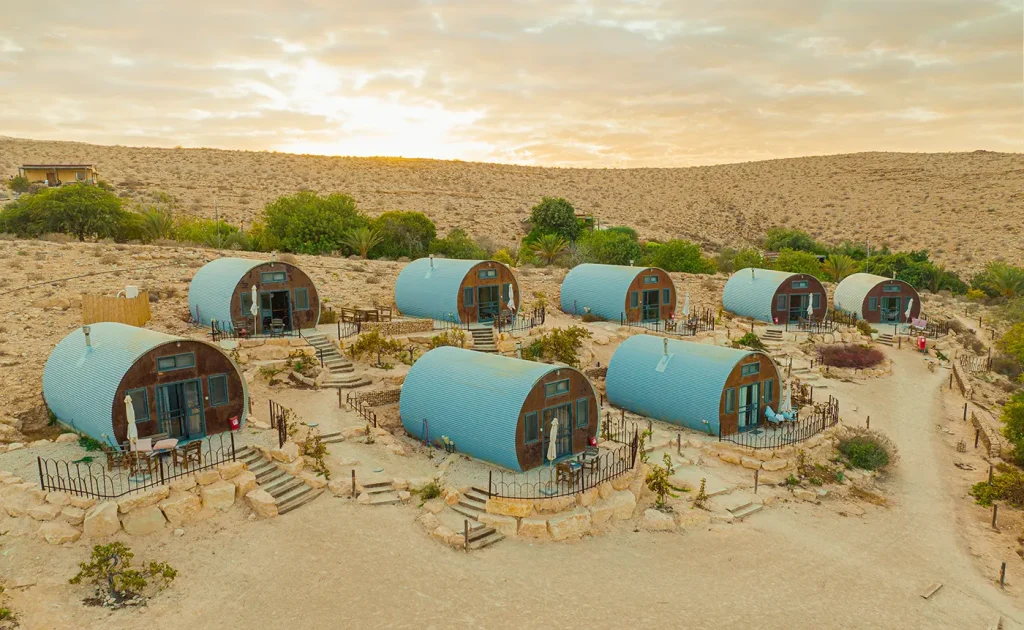
The rooms of Carmey Avdat start from the winery, not from a hotel brochure. The artists’ village, which looks out over the vineyard and the Zin valley from the slope, was designed and built as eight guest units inspired by the winery’s wine barrels. It sits in the heart of the farm, next to the café and the winery.
The village was inaugurated in June 2021, together with the new wine cellar, the visitors’ center and the café. That cellar holds a small surprise: ancient clay jars found in the wine cellars of the ancient city of Avdat, on loan from the Antiquities Authority. A modern cellar, then, with older neighbours, a few minutes’ drive from the place where they were first used.
Built to sit lightly on the slope
A farm in the desert has to answer to the sun, and the building choices show it. The walls of the guest rooms are insulated to twice the standard requirement, and the rooms have energy-saving systems that cut the power when the guest is out. About half of the farm’s electricity comes from a solar system installed in July 2008, and the winery is known as the first in the country to run on solar energy.
An experimental wastewater system treats about 5 cubic meters a day, and the purified water goes back to irrigate the vineyard. The orchards are managed with biological pest control, and guests are welcome to eat the fruit in season. None of this is loud. It is the kind of detail you notice when you ask how the place works.
Two ways to sleep: the village or a cabin on the ridge
Carmey Avdat has 14 guest units in all, which keeps the place quiet. In the artists’ village, each unit has a double bed, a bar table, a fridge, a coffee corner (no kitchenette), a private bathroom with shower, air conditioning with a ceiling fan, an ecological pellet fireplace and a private porch with a seating corner. A coffee machine and a bottle of the farm’s wine wait in the room. For early risers, the porch in front of the room faces the vineyard and the sunrise. The cars stay in the parking area, and the village is a walk of about 40 meters, with help for luggage by club car.
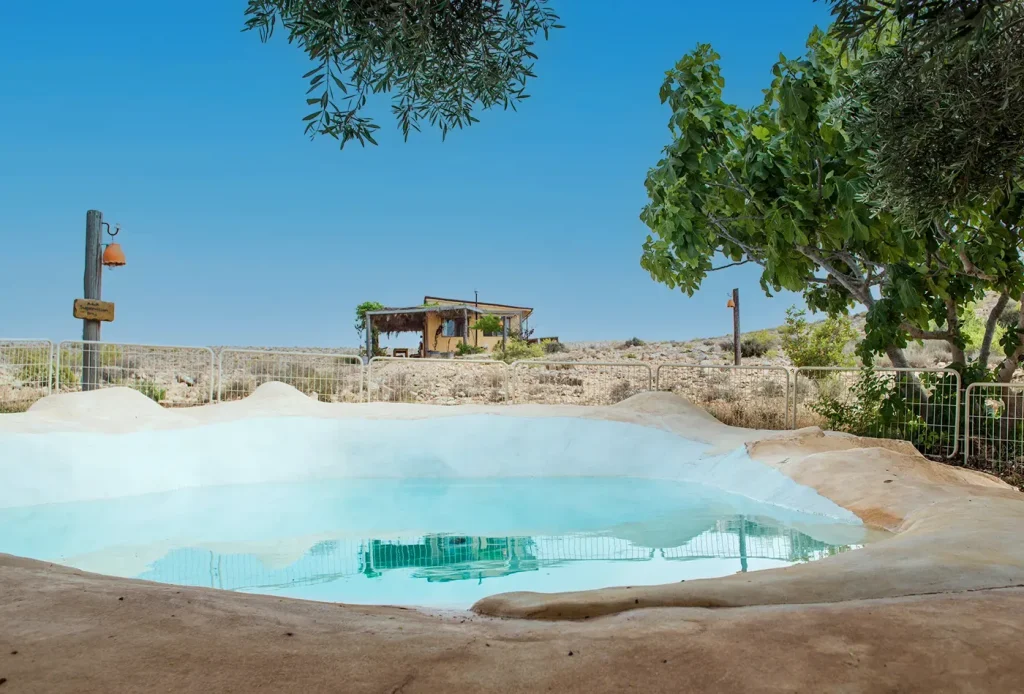
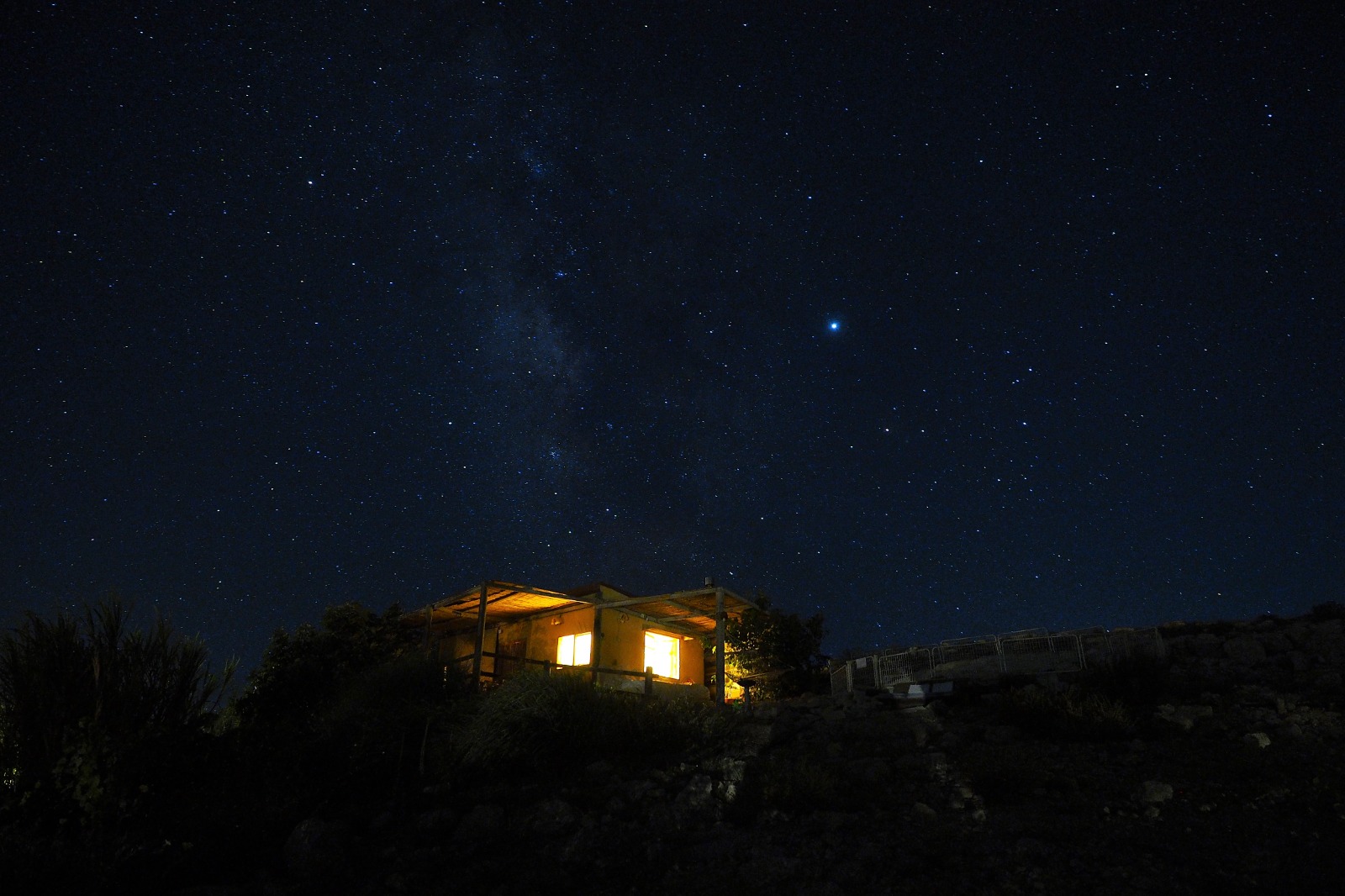
The isolated cabins are a different mood. They are scattered on the slopes of the farm, apart from one another, on a ridge facing the Zin valley and the vineyard. Each has a double bed, a seating area, an equipped kitchen and a pellet fireplace, and the floors are paved with river pebbles from the Nitzana streambed. Outside there is a porch, a hammock, a private fire pit and barbecue corner, and a private jacuzzi. Some also have a sauna and a water-back soaking pool. A short walk from the parking area brings you there. The jacuzzi is only in the cabins; the artists’ village has none.
Where to stay in the Negev Highlands when the day is meant to be slow
The days here are organised around a few simple places. Breakfast for village guests is served at Café Mona, the private café beside the farm’s piazza, which also serves lunch. The café is dairy, runs on Shabbat and holds no kashrut certificate; vegan breakfast is available if arranged in advance. In the evening, the outdoor kitchen on the piazza has a self-service pizza oven, and guests can also order a sunset picnic basket with wine and cheese.
At the winery, tastings cover five wines made on the farm: chardonnay, rosé, a light red, cabernet sauvignon and a dessert wine in the style of port. The dessert wine is called Desert Dessert, and it sits in a small open barrel where visitors pour their own taste. The cellar also has a short film about how the wine is made, which the staff will play on request.
On foot, a loop of about 4.5 kilometers leaves the farm, passes through the rock art park and comes back, in two to three hours. A longer circular route through Nahal Havarim and Ein Avdat takes four to five. A mobile app and an illustrated map carry Eyal’s recorded explanations if you prefer to wander alone. Further out by car: the ancient city of Avdat is about 5 minutes away, Ein Avdat and Ben-Gurion’s Hut about 10, and Ramon Crater about 20.
A few honest notes before you book
The farm is close to an air force base, so aircraft may be heard during the day. The farm is for guests aged 16 and over, and animals are not allowed. The farm’s wines do not carry a kashrut certificate; one kosher bottle can be provided during a tasting on request. A weekend booking is a minimum of two nights. For current rates and offers, it is best to check with Carmey-avdat directly.
Good wine is more than a flavor: it is the memory of a place. A night on this slope, above a vineyard that was already old when Rome was young, tends to work the same way. Cheers, and welcome. The Yizrael family and the farm team.
Frequently asked questions
Where exactly is Carmey Avdat in the Negev Highlands?
Carmey Avdat is a vineyard farm in the Negev, about five minutes from Sde Boker. From the north, take Route 40 south toward Mitzpe Ramon, pass Sde Boker and Midreshet Ben-Gurion, and turn onto the dirt road about a kilometer after the Tzipporim junction. A 700-meter track along the vineyard leads to the parking area.
What is the difference between the artists’ village and the isolated cabins?
The artists’ village has eight units inspired by wine barrels, close to the café and the winery, with a private porch looking over the vineyard. The isolated cabins are spread across the slopes, with a kitchen, pebble floors, a private fire pit and a jacuzzi. The jacuzzi exists only in the cabins.
Can children or pets stay at Carmey Avdat?
No to both. Carmey Avdat hosts guests aged 16 and over, and animals are not allowed on the farm.
Can I taste the wines without sleeping at the farm?
Yes. The winery and Café Mona are open to visitors during the day, and tastings include five wines made on the farm. At weekends and holidays, a seat in the café or winery needs to be booked ahead. The wines have no kashrut certificate, but one kosher bottle can be provided during a tasting on request.
Is there a minimum stay at Carmey Avdat?
A weekend booking is a minimum of two nights. Rates, packages and seasonal offers change, so current prices are best checked with Carmey-avdat directly.
What time is check-in?
Guests can arrive any day of the week from 15:00 and no later than 20:00.
Is there Wi-Fi, and are there TVs in the rooms?
There is wireless internet in all rooms and public areas, and Café Mona has fast Wi-Fi and charging points for remote work. The rooms have no televisions.
Can I charge an electric car at the farm?
Yes, the farm has two slow charging points.
Is the farm accessible for guests with disabilities?
The public areas of the farm, the café and the winery are accessible, there are accessible restrooms, and the walk among the vineyards is accessible too. The accessibility coordinator is Eyal Yizrael, reachable at farm@carmey-avdat.co.il.