Picture a morning that starts on a private balcony: coffee in hand, a vineyard sloping away below, a wide valley beyond it. You could be forgiven for guessing Tuscany, with its hills, its vines and a small piazza in the middle. It is not. This is the Negev, about five minutes from Sde Boker, and the place is Carmey Avdat.
Carmey Avdat is a boutique winery in the Negev with lodging: a family farm in the Negev Highlands that grows grapes, makes wine and lets guests stay a night or two. The whole farm has just 14 guest units, so this piece starts where a stay starts, with the rooms: how they are made and what it is like to wake up in one.
A boutique winery in the Negev with lodging: eight units inspired by barrels
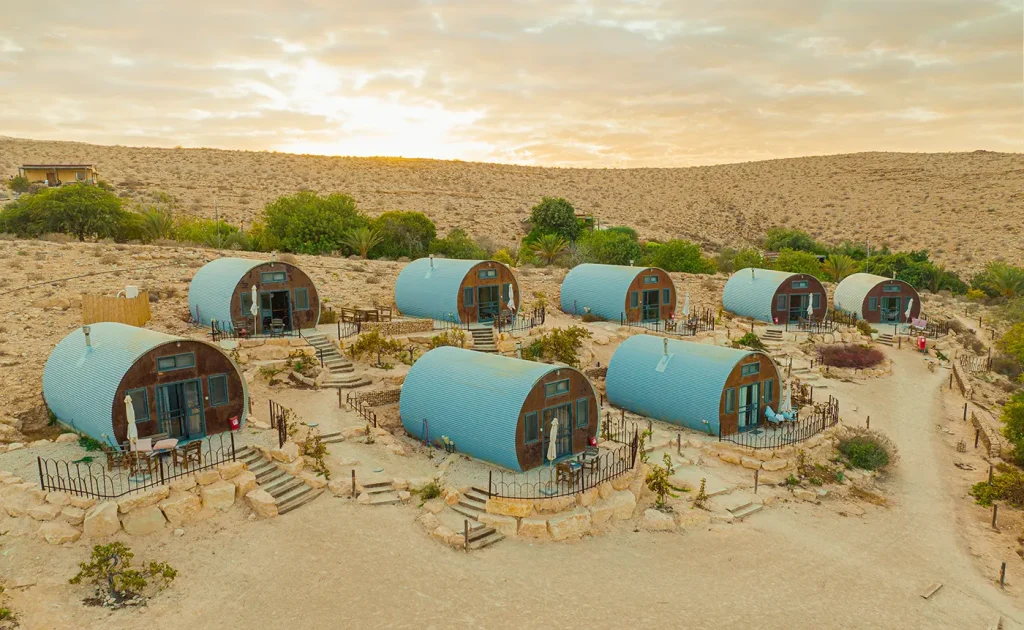
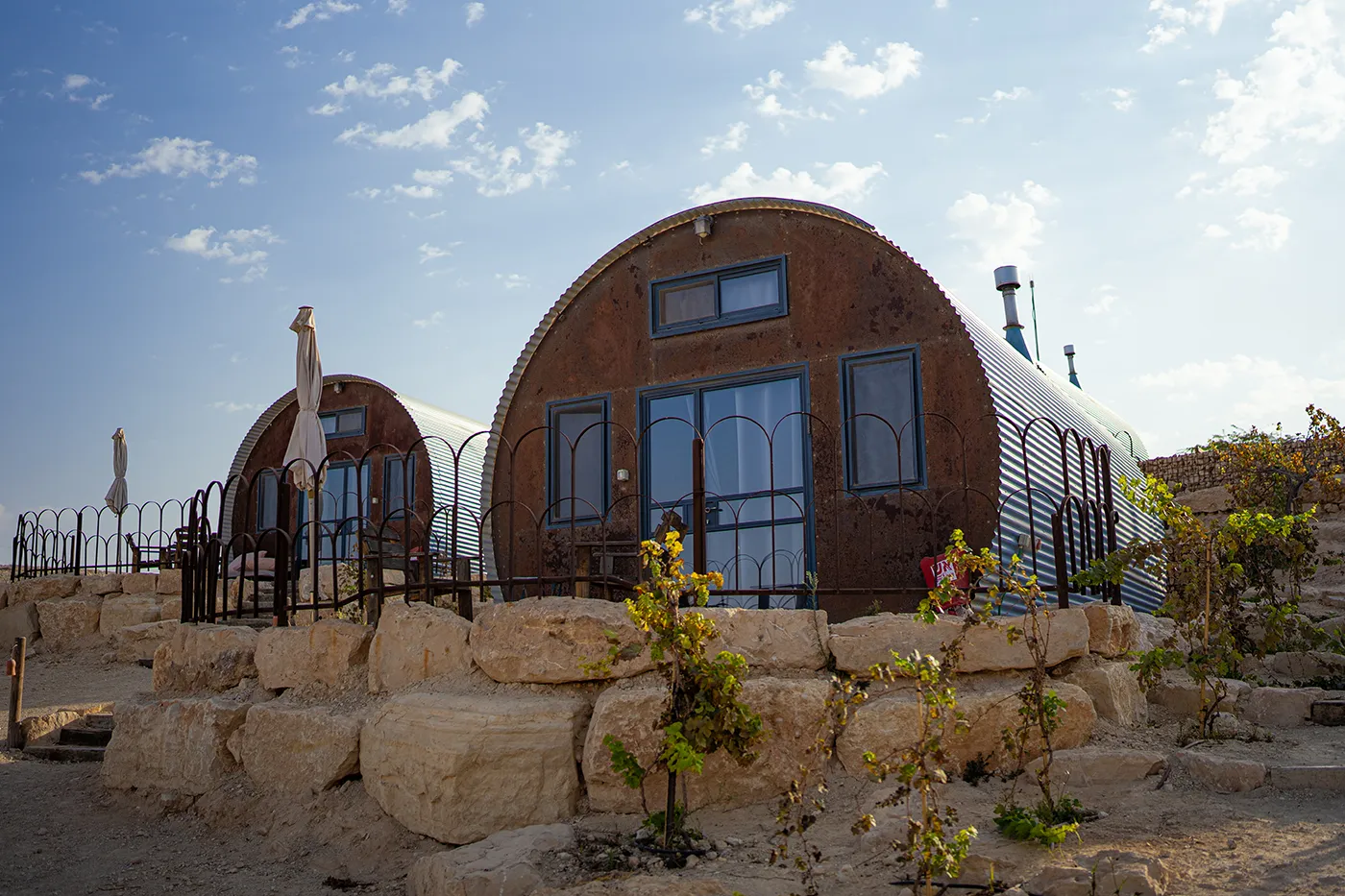
In the heart of the farm, on a slope facing the vineyard and the Zin Valley, sits the artists’ village: eight units for two, designed and built with the winery’s wine barrels as their inspiration. The idea is a simple one. Wine matures in a barrel, quietly and in its own time, and guests rest in a room that grew from the same thought. The units, known as the Artists’ Workshops, stand close to Café Mona and the wine cellar, so the winery never feels like a place you drive out to. It is simply next door.
Inside each unit: a double bed, a bar table, a fridge and a coffee corner. That is a coffee corner, not a kitchenette, and for cooking there are other spots on the farm, which we come to below. There is a toilet and shower, air conditioning with a ceiling fan, and an eco-friendly pellet fireplace for desert winter evenings. Each unit comes with a coffee machine and a bottle of wine, so both the evening and the morning can begin without leaving the room.
The walls of the guest units are insulated to twice the standard, and the rooms have energy-saving systems that cut the power when nobody is inside. It is not a detail anyone gasps at on arrival, but it is the sort you feel after a night in the desert, in July or in January. The farm as a whole draws about 50 percent of its electricity from its solar system.
Cars stay in the parking area, and the walk to the village is about 40 meters. For heavier luggage, the staff help with equipment by club car, so the quiet starts at arrival.
A balcony out front and no television: a day in the unit
Every unit has a private balcony with a seating corner, and for early risers the front of the room looks over the vineyard and the sunrise. There are no televisions in the rooms. There is wireless internet in all rooms and public areas, so anyone who wants to disconnect can, and anyone who must send one last email is not stranded.
Breakfast is a short walk to Café Mona, the farm’s private café beside the central square. That square is our piazza, and it wakes up slowly. In the evening, the outdoor kitchen on the square is open without time limits and has a self-service pizza oven. No waiter, just an oven, and someone will surely prove they can bake a pizza without burning it.
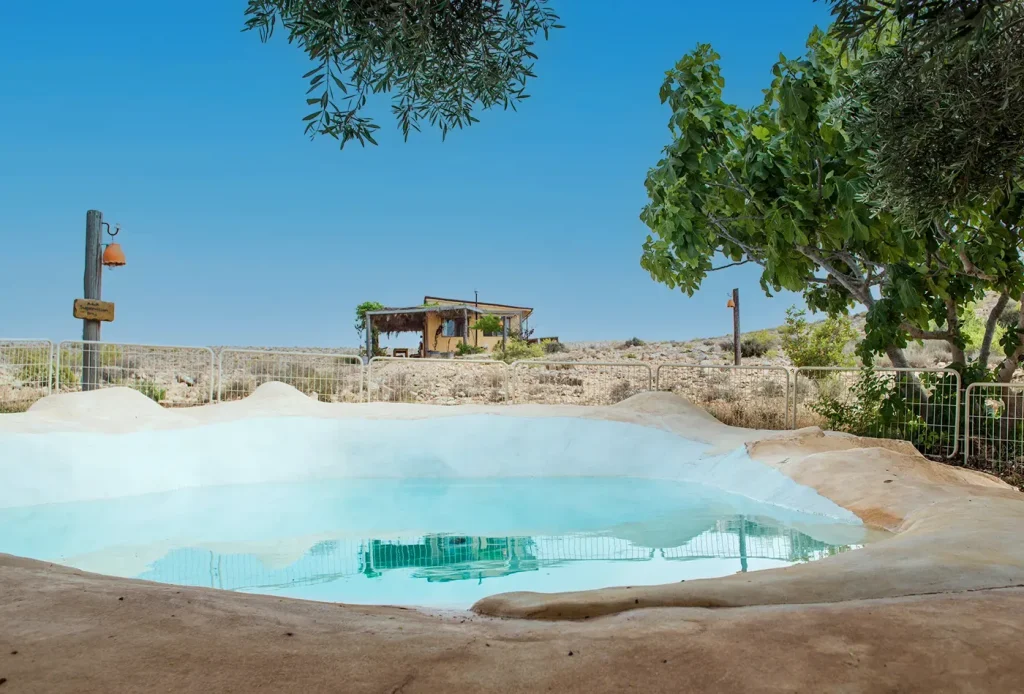
For one more indulgence, the farm has a shared sauna shaped like a wine barrel. It is self-operated and needs to be switched on 40 minutes before use, so light it before you pour the wine, not after. There is no jacuzzi in the artists’ village; that belongs to the isolated cabins. In the farm’s orchard, in the summer season, there is a shared corner of splash pools and hammocks, along with a shared, fully equipped outdoor kitchen.
The isolated cabins: pebble floors, a jacuzzi and a bonfire of your own
Guests who want fewer neighbors and more sky will find both in the isolated cabins. They are scattered across the farm’s slopes, set well apart on a ridge with views over the Zin Valley and the vineyard. Each cabin is a single open space: a double bed, a seating area, an equipped kitchen, a pellet fireplace, a toilet and a shower. The floors are paved with river pebbles from the Nahal Nitzana wadi, one of those places where the floor itself tells you where you are.
Outside there is a balcony with a jacuzzi, a hammock, and a private barbecue and bonfire corner. There is a splash pool, private or shared between two cabins. The walk from the parking area is on foot, up to about 250 meters, so these are cabins for comfortable shoes rather than heels.
The Levona and Ketama cabins suit a couple or four to five adults, with a double bed and three single beds. There are also orchard cabins, built on the same one-space idea but with no view. Anyone who cares about the view should say so when booking.
From the room to the vines: the winery at the end of the path
To understand why the rooms feel as they do, walk up to the vineyard. The farm was founded in 1998 by Hana and Eyal Izreel as part of the Wine Route project in the Negev Highlands, after the family decided, late in life, to grow grapes and make wine in the desert. The vineyard was planted in 1999 and was among the first planted in the Negev in modern times. It sits on the remains of an ancient vineyard some 1,500 years old. Six varieties grow here: Cabernet Sauvignon, Merlot, Petit Verdot, Barbera, Chardonnay and Viognier.
Eyal is the owner, the grower and the winemaker, and visitors who walk the farm with the illustrated map or the mobile app hear the explanations in his voice. The winery makes about 5,000 bottles a year in small batches. Wine tourism here means seeing how it is made and tasting it: a flight of five wines, Chardonnay, rosé, a light red, Cabernet Sauvignon and a dessert wine.
That dessert wine is called Desert Dessert and is made in the style of port, meaning a sweet, weightier wine than a table wine. It waits in a small barrel in the cellar, and guests are invited to pour and taste it themselves. The cellar and visitor center opened in June 2021, with ancient clay jars on display on loan from the Israel Antiquities Authority. For anyone curious about how wine is born, there is a short film about production that the staff will play on request.
Some of the family’s children are already joining the project to carry it on, and you can feel it. This is not an institution. It is a home that keeps growing.
The Negev beyond the gate
A 4.5-kilometer walking route leaves the farm, passes through the rock paintings park and returns, taking two to three hours. For more, a circular route runs through Nahal Havarim and Ein Avdat and takes four to five hours. The landscape is open desert with rolling hills, and there is no noise to get past.
By car, everything is close: the ancient city of Avdat is about 5 minutes away, Ein Avdat and Ben-Gurion’s Hut about 10, and Ramon Crater about 20. The farm, Café Mona and the winery are open to visitors from 09:00 to 16:00.
Before you book: a few simple things
- Stays are for adults only, aged 16 and over, and animals are not permitted on the farm.
- Smoking is not allowed in the cabins.
- Check-in is any day of the week between 15:00 and 20:00.
- A weekend booking is for two nights at minimum.
- On weekends and holidays, seating at the café and the winery requires a reservation.
Rates and offers change through the year, so current prices and promotions are best checked with Carmey-avdat directly. And if the only choice left is between the artists’ village and an isolated cabin: the first is closer to the heart of the farm, the second is closer to the quiet.
We will be in the vineyard with a bottle and half a smile. L’chaim! The Izreel family and the farm team
Frequently asked questions
Can you stay overnight at a boutique winery in the Negev?
Yes. Carmey Avdat, in the Negev Highlands about five minutes from Sde Boker, is a family winery with just 14 guest units. Eight are couples’ units in the artists’ village, designed with the winery’s wine barrels as inspiration, and the rest are cabins. The vineyard, cellar and café are all on the farm itself.
What is the difference between an artists’ village unit and an isolated cabin?
The artists’ village units sit near the heart of the farm beside the café and winery, with a coffee corner (no kitchenette) and a private balcony. The isolated cabins are spread along the slopes, with an equipped kitchen, a jacuzzi on the balcony, a private barbecue and bonfire corner and a splash pool. There is no jacuzzi in the artists’ village; it exists only in the isolated cabins.
Can I bring children or a dog to Carmey Avdat?
Stays at the farm are for guests aged 16 and over, so it does not suit families with young children. Animals are strictly not allowed on the property. The experience is built for couples and adults looking for quiet.
What is there to do around Carmey Avdat besides wine?
A 4.5-kilometer walking route leaves the farm through the rock paintings park, and a longer circular route runs through Nahal Havarim and Ein Avdat. The ancient city of Avdat is about 5 minutes by car, Ein Avdat and Ben-Gurion’s Hut about 10, and Ramon Crater about 20.
Is there a television in the rooms, and where do I park?
There are no televisions in the rooms, but wireless internet covers all rooms and public areas. Cars stay in the parking area, and the walk to the artists’ village is about 40 meters, with help carrying equipment by club car. The isolated cabins are reached on foot from parking, up to about 250 meters.
Is the wine at Carmey Avdat kosher?
The farm’s wines do not carry a kosher certificate. Where kosher wine is needed, one kosher bottle can be provided during the tasting on request. The café kitchen is dairy, open on Shabbat and also without a kosher certificate.
Is the farm accessible for guests with disabilities?
The farm’s public area, the café and the winery are accessible and adapted for guests with disabilities, with accessible toilets and access for walking in the vineyards. The accessibility coordinator is Eyal Izreel, at 0522705328.
Is it noisy at the farm?
Because of the proximity to an air force base, aircraft may be heard at times during the day. Otherwise the farm sits in open desert landscape, far from the bustle of the city.